-
Much different to the US
- By 1902, UK had stronger ideological division
- Not the case now, US has become much more polarised
Variables affecting elections
- Media
- Connections
- Personality of the leader
-
Context
- Cameron: Financial crash
- May: Brexit
- Party Funding in the UK
Two party system
-
19th century: Liberal and conservative
-
20th century: Labour and conservative
-
Two party system does not apply in the devolved system
- Scotland: SNP
- Wales: Plaid Cymru
-
NI:
- Sinn Fein
- DUP / UUP
- Alliance
- SDLP
-
There are 6 parties that represent the whole UK
- Labour
- Conservatives
- Liberal Democrats
- Reform UK
- Green Party
- Your Party
-
If the left splits:
- Lab, YP, Green
-
If the right splits:
- C, Reform
-
Many political commentators think Reform will win the next general election by close margin
-
Council elections in May 2026 will be a bellwether (indicator) of the general election
-
TPP’s prediction: coalition between C and Lib to keep R out
-
If Reform wins: does the Official Opposition become Lab/C without the other?
- Will there be a major constitutional shift?
Multiparty system in Britain
- Multiparty system certainly exists throughout vote share, less evident through seats held
- NI and Scotland have much more multiparty systems
-
Different electoral systems produce more multiparty results
- MEP elections in 2019: Brexit Party won a majority with 29, Green’s 7 beat Con’s 4, Con was 5th
- HoL is multiparty with no party having an official majority
- England is mainly two-party dominant due to FPTP
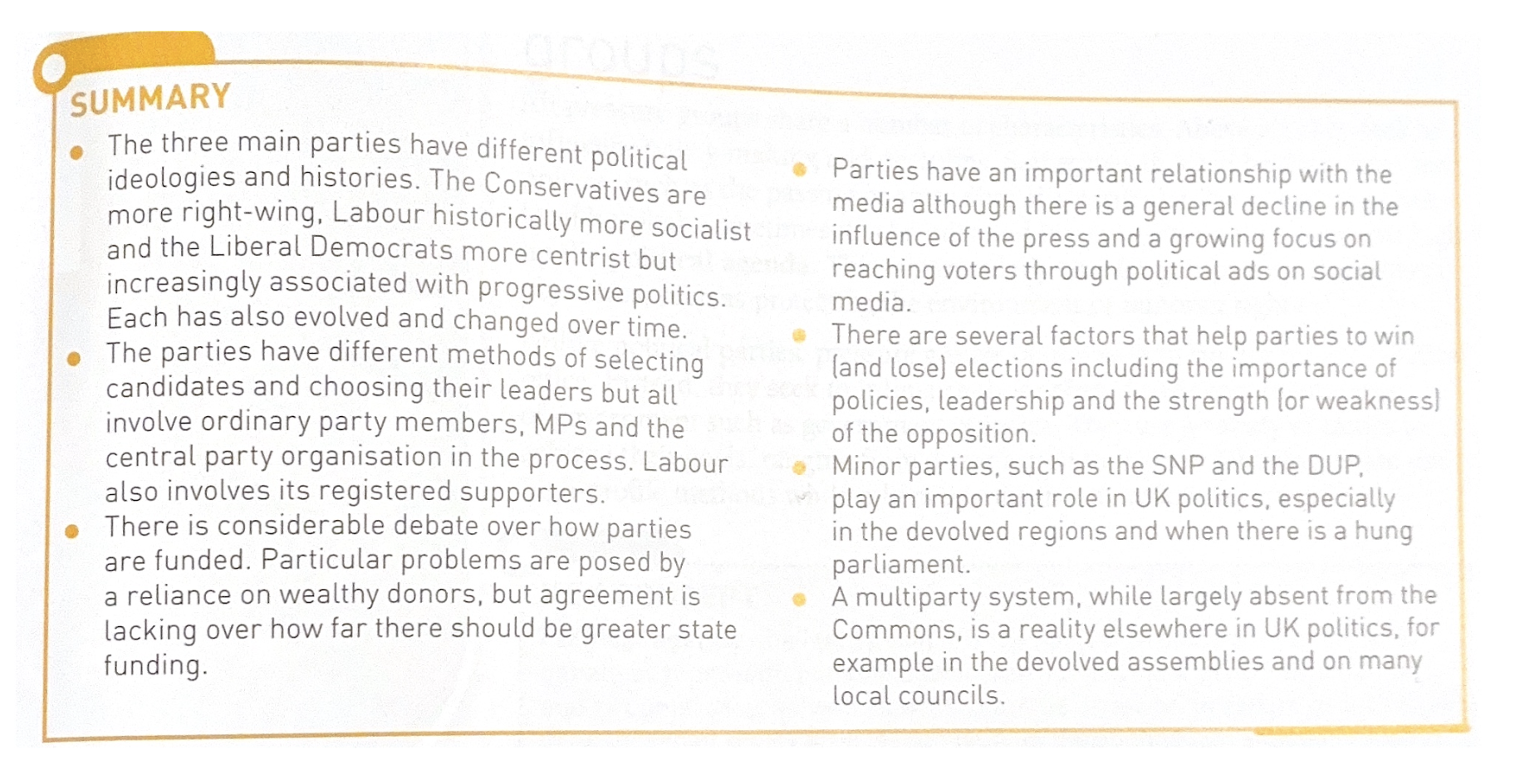
Candidate selection
-
Candidates must be approved by the party after selection/vetting and training
- e.g. Con candidates must pass Parliamentary Assessment Board
- Apply to be shortlisted as the prospective parliamentary candidate (PPC) by local branches
- Candidates get adopted after vote of local party members
- In 2024 Labour’s NEC accused of purging party of left wing candidates
Leadership elections
- Conservative MPs before 1998 chose a leader without consulting the members
-
Before 1965, leaders were generally chosen by the MPs
- Smoking rooms and gentlemen’s clubs
- Discussions between MPs allowed for a leader to emerge
-
Conservatives
- Rules decided by 1922 Committee
- Each contender needs support of 10+ Con MPs
- Con MPs use secret ballots to select four candidates
- Four candidates give a speech at annual conference
- Further ballots reduce to two
- Final two face off in online vote by all Con members (OMOV)
-
Labour
- Candidates need backing of 10% of Labour MPs, 5% of constituency parties or at least three affiliates (two of which must be tradde uninos)
- Candidates are elected by all members through preferential vote, OMOV
-
Lib Dems
- Support by 10% of Liib Dem MPs ad support by at least 200 members from 20+ local parties
- Voted by OMOV using AV
Development of modern parties
1689-1850
- Early parties were based upon grouping MPs around a figure/leader
- Whigs and Tories
-
Whigs were more pro-reform, wanted constitutional change to limited government
- Limits on powers of government
-
Tories
- stood for defence for the Church of England
- stood for protecting the aristocracy
- stood for limited change
1800s – modern parties
-
Modern parties developed ~1850
- Period of Robert Peel, Benjamin Disraeli, William Ewart Gladstone
1832
-
Great Reform Act (Milestones of the British Constitution)
- Increased electorate
- Robert Peel
- Writes the Tamworth Manifesto (1834)
-
Repeals the corn laws, splits the Tories into Peelites and Conservatives
- Peelites join with the Whigs and Radicals to form the Liberal
- Conservatives become dominated by Disraeli
1867
- Reform Act passed by Disraeli (Conservative)
1884
- Representation of the People Act passed by William Gladstone (Liberal)
1906
- Liberal landslide, 397 seats vs Conservatives’ 156
1916
-
LLoyd George becomes Liberal PM during WWI
- Last Liberal PM
- Women over 30 get suffrage (Representation of the People Act 1918)
1945
- Landslide Labour victory, 393 vs Conservatives’ 190, Liberals have 12
- Leadership of Conservatives was Churchill
- Clement Attlee becomes PM
- First big socialist government